Type
Passive income experiment
Role
Designer + Builder + Owner
Monetization
Affiliate · AdSense · Subscription
Status
Live · passive income
Starting Point
A product test built around something I actually use
The goal was specific from day one: build a passive income product, something real and live, generating revenue while I sleep, without giving up on design quality. The constraint I set for myself was that it had to be something I genuinely love and use daily.
The Pomodoro technique was the obvious starting point. I've used it for years. But most tools in this space get the environment wrong. They treat the timer as the product, when for most people the timer is just a scaffold for a whole ritual around focus.
Design Process
From "music to study" to a full environment system
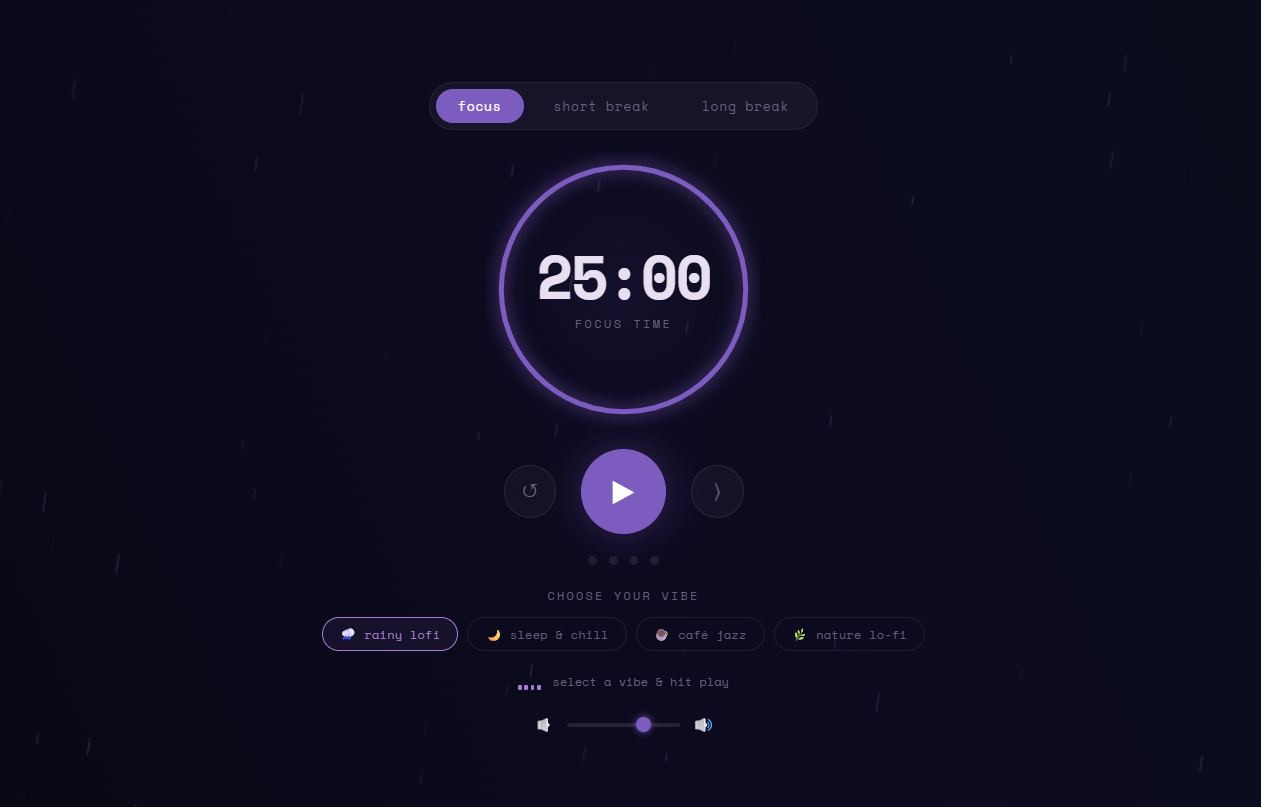
I started by mapping what I actually do when I sit down to study or do deep work. The first thing I reach for is music, specifically instrumental, lofi, ambient. "Music to study" is a whole genre with its own aesthetic and emotional register.
That realization unlocked the product's core idea. If the music creates atmosphere, then each playlist is really an environment. A rainy jazz café. A night city. A cozy library. The timer lives inside a place that puts you in the right headspace.
From there, the design extended naturally into the physical. If someone is intentionally building a study environment around their screen, they're also thinking about what's on their desk. That's where the product concept clicked into a business model: the affiliate layer.
These aren't random products. They're the physical artifacts of a study environment, the things someone who cares about their focus ritual actually buys. The decision was to surface them contextually, as part of the atmosphere, not as an ad unit.
Instrumentation
Building a tracking system that could actually teach me something
The product is built around three monetization streams: Amazon affiliate commissions, Google AdSense display, and a Stripe-powered premium subscription ($4.99/month or $19.99 lifetime). That complexity required deliberate instrumentation, not just Google Analytics on the page but a system I could actually read.
Each of the six affiliate items has its own Amazon tracking ID, so I can see precisely which product drives clicks and which converts. On the GA4 side, I instrumented three key events: affiliate_click, open_premium_modal, and premium_click. The three moments where a session becomes revenue.
Setting this up end-to-end (tagging, testing, verifying events fire correctly) was one of the most satisfying parts of the whole project. It's a small system, but designed deliberately. Every data point maps to a decision I might make later.
Growth
When the product outgrew the tool
A timer is a feature, not a business. That became concrete when I moved to activate display advertising and the platform flagged the site as "low-value content." It was a fair critique: a beautiful single-purpose utility gives a visitor no reason to stay, return, or be discovered through search.
So I treated distribution as a design problem. I built a content layer around the product — a proper About, Privacy and Terms foundation, editorial content on the home explaining the Pomodoro method and the mechanics of focus, and a four-article blog (~3,400 words) covering studying with lofi, the Pomodoro Technique for ADHD, building a focus playlist, and beating procrastination with time blocking.
This reframed StudyVibes from a utility into a small content property: something with an SEO surface area, a reason to return, and a narrative that positions the affiliate and premium layers as genuinely useful rather than bolted on. The same product thinking that shapes an interface decides whether anyone ever finds it in the first place.
What I Learned
Owning the full loop changes how you design
In client work, design decisions and business outcomes are separated by layers: PMs, engineers, timelines, other stakeholders. Here there were no layers. A decision about where to place the affiliate widget is a revenue decision. An event I forget to tag is data I'll never recover.
That directness sharpens your instincts fast. It also made me a better collaborator on client work, because I understood more viscerally what it feels like to own the outcome, not just the design.
Results
Early traction, growing intelligently
The product is live and generating real, passive revenue through affiliate commissions and early premium subscribers, with display advertising being activated as the site clears content review. It's early-stage and the numbers are still accumulating, quietly, in the background.
The next phase is data-informed: understanding which environments drive affiliate clicks, optimizing the premium modal conversion, growing the content engine to compound organic traffic, and expanding the playlist catalog to increase session depth. The instrumentation built at launch makes all of this tractable.
Visit StudyVibes →